← Blog· · 12 min read
How to measure progress in the gym: a beginner-to-advanced guide from my own cut and bulk
I trained by feel for years. Then I logged a cut from 86.8 to 74 kg and the bulk after it. How I measure progress now: lifts, rest times and scans.
For years I trained by feel. I went to the gym, did what felt right that day, pushed hard and went home. In the beginning that was enough: the weights went up almost every week, and I didn't need a log to see it.
Then it stopped being obvious. Was I stronger than last month, or just having a good day? Was my bench stuck, or had I rested longer than usual? I had no idea, because I'd never written anything down. My log has one week from November 2024, six workouts in an app, and then nothing until May 2026. Looking back, that was my biggest mistake. It wasn't the program or the diet. I just couldn't tell if any of it was working.
This post is how I measure progress now, from the basics to the details that only matter later. Every number in it comes from my own log: a cut from 86.8 kg and 20% body fat down to 74.0 kg and about 12%, and the bulk I'm in now.
The short answer
- Log your main lifts. Write down weight and reps for every working set. Progress means more weight or more reps on the same lift over weeks.
- Log your rest times. Otherwise you can't tell if you got stronger or just rested longer.
- Track your body weight as a trend, never as one weigh-in.
- Judge over 4–8 weeks, not one session.
My numbers at a glance
| Start of the cut | End of the cut | Now (bulk) | |
|---|---|---|---|
| Date | 12 Dec 2025 | 8 Aug 2026 | early Oct 2026 |
| Body weight | 86.8 kg | 74.0 kg | 75.4 kg (last scan, 22 Aug) |
| Body fat (scan) | 20% | 12.2% | 13.3% (22 Aug) |
| Deadlift, best set | not logged | 135 × 6 | 145 × 5 |
| Incline bench (Smith) | not logged | 80 × 5 | 85 × 7 |
| Seated cable row | not logged | 57.5 × 9 | 68 × 8 |
Step 1: stop training by feel and start logging
The simplest thing that works: for every working set, write down the exercise, the weight and the reps. You don't need spreadsheets or formulas to start. You just need the same lifts, written down the same way every time.
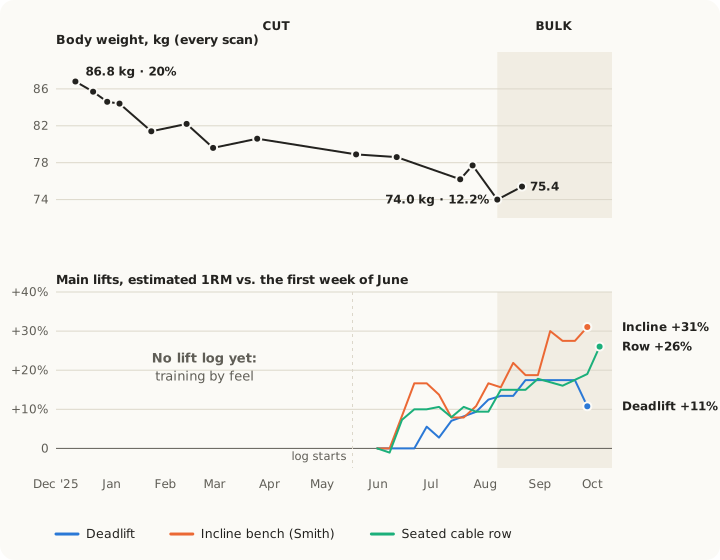
The chart shows what changed for me. From December to May I was cutting without a lift log. The scale went down (86.8 to 78.9 kg), but I couldn't tell you what my lifts did. From 18 May I logged every workout, four to five a week. From then on, every week had an answer: up, same or down.
Once you have that, progress has a clear meaning. You did more than last time on the same lift: more weight, more reps at the same weight, or the same work with less effort. That's progressive overload, and it's what almost every good program has in common.
It's also why I don't change my program on a schedule. My deadlift, Smith incline bench and cable row have been in my routine since May. In four months I swapped two lifts: the Smith flat bench for the barbell bench at the end of July, and the dumbbell shoulder press for the barbell overhead press in September. If you change every lift every few weeks, you never get two numbers you can compare.
Step 2: judge by a few main lifts, and compare like with like
I log every exercise, but I judge my training by a handful of compound lifts: deadlift, bench (incline and flat), overhead press, and rows. If those go up over a couple of months, the program works. Curls and raises are logged too, but I don't judge my training by them.
To compare sets with different reps, I use an estimated one-rep max (e1RM). 120 kg × 6 and 135 kg × 5 are hard to compare by eye. As e1RM they're 144 kg and 157.5 kg, on the same scale. I use the Epley formula: weight × (1 + reps ÷ 30).
Two rules I learned from my own log:
- Only compare the same exercise. In July my best Smith flat bench was 95 × 8. My first week on the barbell bench was 90 × 6. That wasn't me getting weaker. It's a different lift, so it starts a new line.
- The log shows what's stuck, not just what's moving. My barbell bench was 90 × 6 at the end of July, then 85 × 6 for five weeks in a row in August, and only back to 90 × 6 in the week of 21 September. That's two months without progress. Training by feel, I'd have called that "fine".
Step 3: log your rest times (the one that surprised me)
Rest changes how much you can lift in your next set. In one study, trained men who rested 3 minutes between sets gained more strength on squat and bench than men who rested 1 minute on the same program (Schoenfeld et al., 2016). So if you rested 90 seconds last week and 3 minutes this week, an extra rep means less than you think.
In September I started ticking each set in Sparlift as I finished it, so the app records the time between sets. Until then, my routine's rest timer said 90 seconds on every main lift. In September it said about 2 minutes. Here's what I actually took:
| Lift | Rest timer in September | Time from one set to the next (median) |
|---|---|---|
| Deadlift | about 2 min | about 5 min |
| Incline bench (Smith) | about 2 min | about 5 min |
| Overhead press | 2 min | about 5.5 min |
Everything else took 3.5–4.5 minutes from one set to the next. These times include the set itself, so the real rest is maybe half a minute shorter. That's still two to three times longer than my timer said. It's also only a few weeks of data. But it changed how I read my summer: I have no idea how long I rested before September, so I can't say how much of that progress came from resting longer.
What I do now: I set the timer to what I really need on the big lifts (2.5–3 minutes) and stick to it. A new rep only counts as progress if the rest was about the same. Sparlift saves the rest you used back to your routine, so the next workout starts with the same timer.
Step 4: on a cut, holding your lifts is the win
When you eat less, you shouldn't expect your lifts to go up every week. The question is simpler: are the main lifts holding while the weight comes down? If they are, most of what you're losing is fat.
My cut took 34 weeks: 86.8 kg to 74.0 kg, about 0.37 kg a week, or 0.4% of my body weight. That's slow. A common guideline for keeping muscle is 0.5–1% a week (Helms et al., 2014).
My lifts didn't just hold. They went up. From the first week of June to the first week of August, while my weight went from 78.6 kg (12 June) to 74.0 kg (8 August):
- Deadlift: 120 × 6 → 135 × 6, e1RM +12.5%
- Incline bench (Smith): 60 × 10 → 80 × 5, e1RM +17%
- Dumbbell shoulder press: 25 × 9 → 32 × 7, e1RM +21%
Don't expect this on every cut. I think it happened because I'd never trained with a plan before, so a real program had a lot of easy progress left, and the cut was slow. On a fast cut, or after years of structured training, holding your numbers is the realistic goal.
Two things in my data that would have fooled me if I'd looked at single readings:
- One weigh-in lies. On 18 July I weighed 76.2 kg. A week later, in the middle of the cut, 77.7 kg, on the same machine. That's 1.5 kg of water and food, not fat. Look at the trend over weeks.
- Body fat machines disagree. On 20 May an InBody scan said 12.3%. On 12 June a DEXA scan said 16.0%, at almost the same weight (78.9 vs 78.6 kg). That's almost 4 points between machines. So compare scans from the same machine, under the same conditions, and trust the direction more than the number.
Step 5: on a bulk, the log tells you if it's working
I switched to a bulk in August. The questions change: am I gaining weight slowly enough that most of it is muscle, and are my lifts going up again?
So far, for the lifts, mostly yes:
- Incline bench (Smith): 75 × 7 → 85 × 7 (e1RM +13%)
- Incline dumbbell bench: 32 × 9 → 38 × 8 (+16%)
- Seated cable row: 57.5 × 11 → 68 × 8 (+10%)
- Barbell overhead press, new in September: 50 × 7 → 55 × 7 in three weeks
But not everything. My deadlift reached 145 × 5 in the week of 24 August and did exactly that every deadlift week until 21 September. In the week of 28 September, which I trained six days in a row, it was 145 × 3. That's a stall, and without a log I wouldn't have noticed it for months. (What six days in a row did to my training stress is its own post.)
For body weight, here's the honest part: my scans stop on 22 August. The first two weeks of the bulk added 1.4 kg (74.0 to 75.4 kg). That's fast on paper, but a lot of it is the water and carbs coming back, the mirror image of the first weeks of a cut. Since then there's nothing in my log. For a bulk, that's the number that matters most, so that's the gap in my own log I'm fixing next. A common target is about 0.25–0.5% of body weight a week for beginner and intermediate lifters (Iraki et al., 2019), which for me is 0.2–0.4 kg.
The rule I use: if the weight climbs and the lifts don't, the surplus is too big. If the lifts climb and the weight doesn't, I can eat a bit more.
Beginner vs. advanced: what to track
| Beginner (first year) | Intermediate and beyond | |
|---|---|---|
| Log | Weight and reps on every working set | Plus rest times and effort (reps in reserve) |
| Judge progress by | More weight or reps almost every week | e1RM trend over 4–8 weeks |
| Body | Weigh-ins as a weekly trend | Weekly trend, waist, scans on the same machine |
| Change the program | Rarely; you're progressing anyway | When a main lift stalls for several weeks |
As a beginner you can add weight almost every week, so the log is mostly confirmation. Later, progress slows down to a few kilos a month on a good lift, and a bad week can hide a good month. That's when you can't see progress without a log, and that's exactly where I got lost when I trained by feel.
Start logging, free · See what Sparlift tracks
FAQ
How do I know if I'm making progress in the gym?
Compare the same lifts over weeks. If you're lifting more weight or doing more reps on your main lifts than a month ago, with about the same rest between sets, you're progressing. One good or bad session doesn't mean much; the trend over 4–8 weeks does.
Should I measure progress by strength or by how I look?
Both matter, but strength is easier to measure. Mirrors and photos depend on light, pump and water, and body fat machines can disagree by several points. Use your main lifts as the main signal, and add photos, a waist measurement or scans on the same machine every few weeks.
How often should I change my workout routine?
When a lift stops progressing, not on a schedule. If your main lifts are still going up, keep the routine. Changing everything every few weeks means you never have two numbers to compare. Swapping an accessory now and then is fine.
How do I know if I'm losing fat or muscle on a cut?
Watch your main lifts. If they hold or go up while your weight goes down, you're mostly losing fat. If they drop fast, the deficit may be too steep. A common guideline is losing 0.5–1% of your body weight a week.
Why did my weight loss stop after a few weeks?
The first weeks of a cut include a lot of water and stored carbs, so the scale drops fast. After that, fat loss is slower, and daily swings of a kilo or more hide it. Look at your trend for 2–3 weeks before changing your diet.
Why does my body fat % change so much between machines?
Machines like InBody and Visbody estimate body fat from how electricity passes through you, and DEXA uses an X-ray scan. They use different methods, and water and food change the readings. My InBody and DEXA scans three weeks apart differed by almost 4 points at the same weight. Compare readings from the same machine, under the same conditions.
How long should I rest between sets?
For the main lifts, longer rests (2–3 minutes or more) let you do more in the next set. Whatever you choose, keep it about the same from week to week, so your numbers stay comparable. Measure it: mine was much longer than I thought.
How do I know if my bulk is working?
Your weight goes up slowly, about 0.25–0.5% a week, and your main lifts go up with it. If the weight climbs but the lifts don't, the surplus is probably too big.
Do I need an app to track my workouts?
No, a notebook works. An app makes the comparisons automatic: last time's numbers, rest times and e1RM trends are there when you need them. I built Sparlift for exactly that, and I log every workout in it.