← Blog· · 15 min read
What 286 workout notes taught me about tracking progress
286 workout notes, a third of them setup I'd typed before. What my notes track, why I built pinned notes, and how to track bag rounds like gym sets.
This is the last note I wrote on my bench press before I moved my log out of Hevy:
31 rack, 50 visible pin
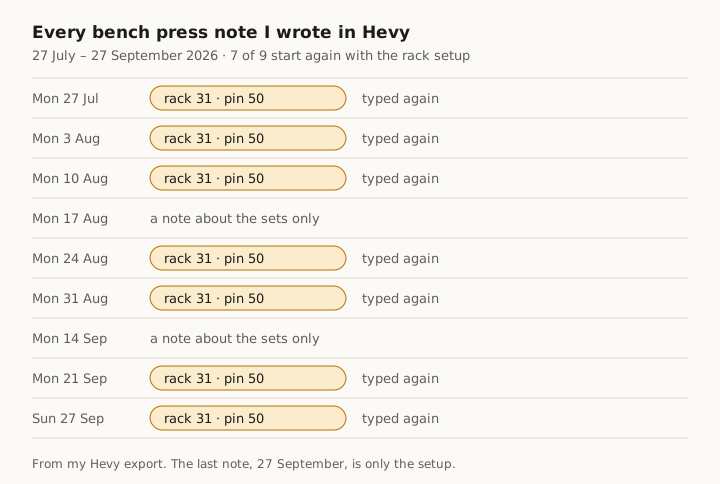
That's the whole note. No sets, no "felt heavy", no plan for next week. Just the two numbers I need before I can lift: the safety rack on hole 31 and the J-hooks on pin 50. It was the seventh time I had typed them in two months.
I didn't need to remember them. I needed to see them, every time, before the first warm-up set. So I built that into my own log. It's called a pinned note, and it has one job:
Write it once. See it every set.
The short answer
- More than half my exercises had a note. From 20 May to 27 September I logged 84 workouts in Hevy. 286 of my 507 exercises got a note, about 8,100 words in total.
- A third of those notes were setup. By my count, 94 of them: rack holes, bench pins, which cable gate, which Smith machine, where my hands go. The same facts, typed again and again.
- Half of them said how hard it felt. "Grind", "easy", "heavy": 143 notes. Only 10 used the words "RIR" or "in reserve". That gap is why every set in Sparlift has a RIR column.
- Notes are the most useful thing I log. The sets say what I did. The notes say under which conditions: which machine, which side was weaker, what came before, which reps needed help. Without that, two sets aren't comparable.
- Pinned notes fix that. In Sparlift you pin a note to the exercise, not to one workout. It sits at the top of that exercise in every workout, in every routine, with no tap, and it works with no signal.
- You can pin an old note in one tap. That includes the one you wrote five minutes ago.
- The bag counts too. I believe you can make the same progress in a fight gym as in a weight room, if you track it the same way: which bag, which gloves, and how the round went, not only "3 × 3 min".
What my notes were really about
I write a lot of notes. Some are about the sets: how many reps were clean, where I started to grind, what I want to try next week. Those belong to one workout, and that's fine.
But when I went back through four months of them, a different kind of note kept showing up: the setup. And setup doesn't change from one workout to the next. I was writing the same thing on purpose, because the alternative was forgetting it.
Three examples from my own log:
- Bench press: rack 31, pin 50. It's in 7 of my 9 bench notes, from 27 July to 27 September. On 27 September I didn't even write anything else.
- Incline press on the Smith machine: pin 3, not 4. On pin 3 I feel my chest; on pin 4 more of it goes to my shoulders. I found that in July and wrote it down twice. On 6 August I forgot to set it anyway, felt the difference, and wrote this to myself: "definitely 3!! … i need to remember that incline push is pin 3 not 4." Then I wrote "pin 3" in my next two notes too. A note written to remember is no use if you only read it after the set.
- Overhead press: pin 68. Three workouts in a row. In the first I wondered if 69 would unrack easier; in the second I settled it: "68 visible pin better." A decision like that should be made once and then stay in front of me.
And then there's the gym itself. 18 of my notes are about a bench, rack, cable or handle that was taken, missing or broken (a few of them are not printable). Every time that happens I end up on a different station, and a different station means different numbers. One of my pulldown notes says it best: "34 feels at least like 60." Two cable stacks can feel a whole weight class apart. If you want to compare your sets week to week, you need to know which one you were on.
What 286 notes track, and why notes matter most
I went through every note and sorted it by what it talks about. It's a word search (pin, rack, gate; grind, easy; left, right; and so on), so treat the numbers as close, not exact. Most notes talk about more than one thing: 188 of the 286 land in two or more rows.
| What the note is about | Notes | Share | From my log |
|---|---|---|---|
| How hard it felt | 143 | 50% | "Very hard grind 2nd set, stay on 18" |
| Setup: machine, station, hands | 94 | 33% | "Pin 68 visible, rack 37, do it with pause" |
| Technique and cues | 92 | 32% | "Key factor is to stand still and straight" |
| What changed: order, sets, exercise | 66 | 23% | "I did this after hammer curl" |
| Rep quality: partials, help, bounce | 61 | 21% | "Last 2 reps with help of other hand" |
| A plan for next time | 56 | 20% | "Next time 36" |
| Left vs right | 44 | 15% | "Right consistently 8, left consistently 10" |
| Body, sleep, food, mood | 32 | 11% | "Maybe calorie deficit" |
| Rest between sets | 25 | 9% | "Increased rest time to 3:30" |
| Equipment taken, missing or broken | 19 | 7% | "Pulldowns were busy" |
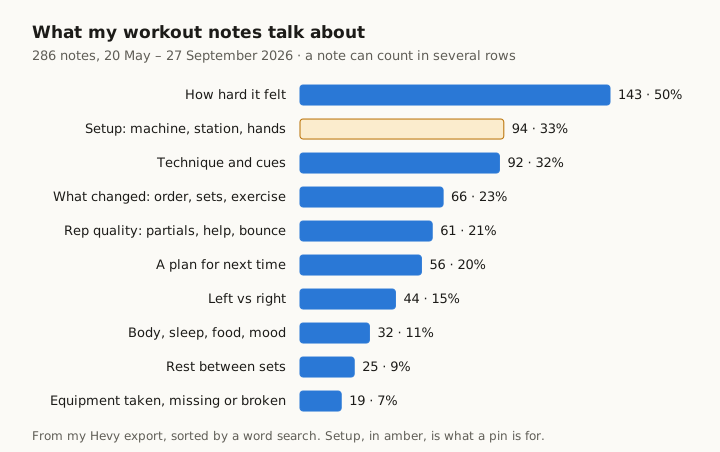
Setup on its own breaks down like this: rack holes, pins and J-hooks in 37 notes; which machine, station or gym in 29; where my hands and feet go in 22; the bench or seat position in 19; the cable gate, height or stack in 19.
Three things in that table changed how I built Sparlift:
- Effort needs a number. Half my notes say how hard a set was, in words that don't compare: "grind", "rather easy", "crazy". Only 10 of them said RIR (reps in reserve). That's why every set in Sparlift has a RIR column: one tap, 0 to 4+, and "grind" becomes a 0 you can put next to last week's 1.
- Sides need their own rows. 44 notes compare my left and my right, usually to say one side was weaker. On one-arm exercises Sparlift logs each side as its own set, so the gap is in the numbers, not in a sentence.
- The rest is context, and context is what makes numbers honest. "8 reps" after a rested start and "8 reps" after preacher curls, on a different cable stack, with the last two helped by the other hand, are not the same set. The log only shows the 8. The note shows the rest.
That's why I think notes are the most powerful tracking tool in any log. The sets give you numbers. The notes tell you which numbers you can compare. And when the same note keeps coming back, it isn't a note any more, it's a setting, and settings belong at the top of the exercise.
Why I left Hevy, and the note I kept missing
I logged my lifting in Hevy. When I moved my log out of it at the end of September, I couldn't find a way to make a note follow an exercise. A workout note stayed with that workout. A routine note stayed with that routine, and the same bench shows up in more than one of mine. So I kept typing.
It wasn't the only reason I started building my own log; the rest are a story for another post. But it was one of the reasons, and the one I felt in every single workout.
To be fair to Hevy: its features page now lists pinned notes, marked as new. I left before that, so I haven't tried them. If you're happy in Hevy, check it out. I'm glad the idea is spreading; I think every training log should have it.
How to remember your gym machine settings: what to pin
Not every note should be pinned. A pin is for what stays true until you change it. From my notes, setup comes in six kinds:
- The numbers on the machine. Rack hole, J-hook pin, safety height, seat height, back pad, the bench angle. Rack 31, pin 50.
- Which machine or station. My gym had three Smith machines, and they didn't feel the same. First Smith from the racks. Middle cable gate.
- Where your hands and feet go. The easiest thing to lose between workouts. Wrist extension: knees close, elbows in line with shoulders.
- How to count the weight on this machine. Plate-loaded or dual handles make your log lie if you don't decide once. Both handles: count the stack × 2.
- The one cue that works for you. Not a list of ten. One. Push with the chest, shoulders down.
- What not to do again. The experiment that didn't work, so you don't run it twice. No bulldog grip on the Smith, my wrists don't like it. Normal grip.
If a note is about how today went ("last set was a grind"), it's a normal note. If it's about how to start next time, pin it.
How pinned notes work in Sparlift
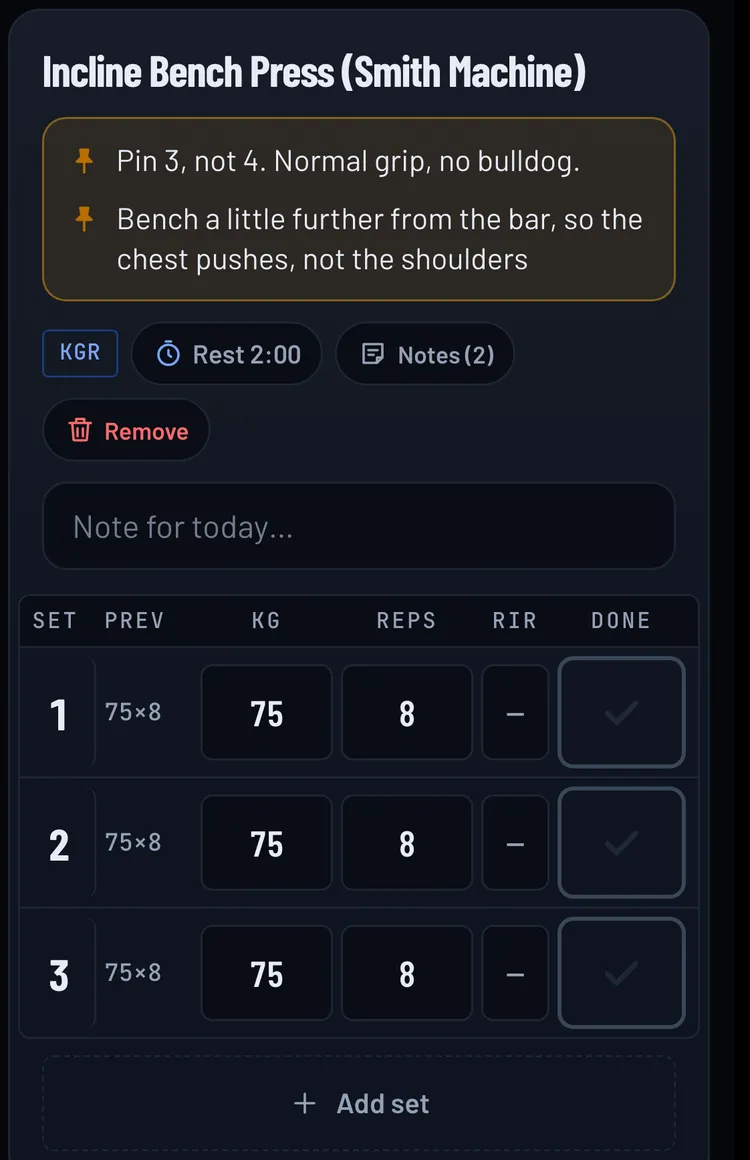
- At the top of the exercise. Your pins sit in a small amber panel right under the exercise name, above the sets. It's the first thing you read when you walk up to the machine. If an exercise has no pins, nothing changes on its card.
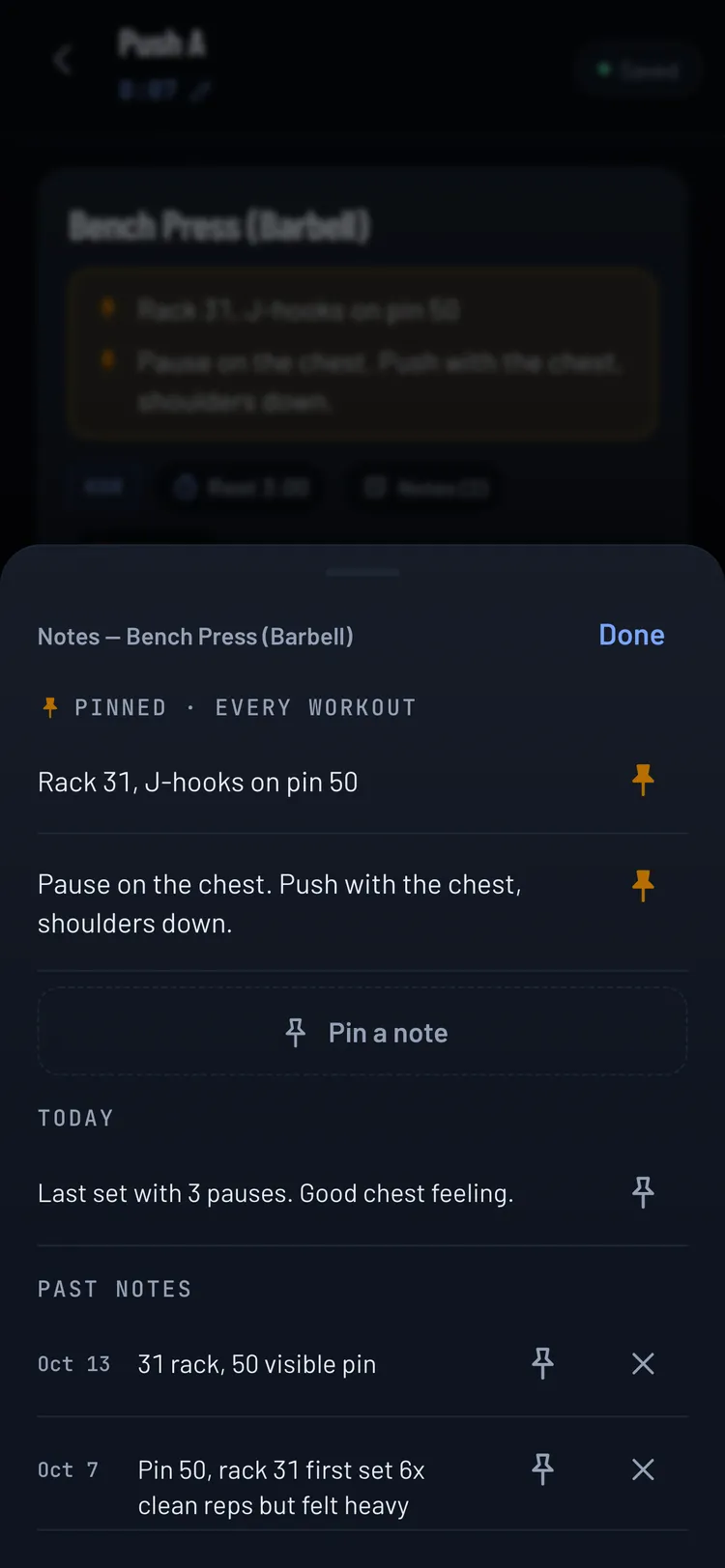
- One Notes sheet. Tap Notes on an exercise and you get three parts: Pinned (tap a pin to edit it, tap the pin icon to unpin, with Undo), Today (pin what you just wrote), and Past notes (every note from earlier workouts, each with a pin button).
- Pin an old note in one tap. Found the note where you finally got the setup right? Pin it. The pin is a copy, so you can trim it down to the two numbers that matter without touching the original.
- Every routine, every workout. A pin belongs to the exercise. Push A, Push B or a quick workout with no routine: the bench shows the same pins.
- No signal, no problem. Gyms and basements go together. Pins live on the phone, show up offline, and you can pin, edit and unpin offline too. Everything syncs when the connection comes back.
- Up to 10 pins per exercise. More than that and you stop reading them, which defeats the point.
Track the bag like you track the bench
I train kickboxing as well as lifting, and I believe you can make the same progress in a fight gym as in a weight room. Not "get fitter by showing up": measurable progress, round after round, the way a bench press goes from 80 to 85. What's usually missing is the tracking.
Many people log bag work as "3 rounds, 3 minutes". Week to week it looks identical. But then it turns out one week was the heavier bag. Another week, different gloves. And one round they went all out in the first thirty seconds, and the next two and a half minutes were weak. "3 × 3 min" hides all of that, the same way "8 reps" hides that I was on a different cable stack.
Notes measure it the same way they measure my setup in the gym. Split it like a lift:
- What stays the same goes in a pin. Which bag, glove weight, wraps, the round setup. Heavy bag by the ring, 16 oz, 3 × 3 min, 1 min rest. Now every round you log is on the same bag with the same gloves, or the note says it wasn't.
- How the round went goes in today's note. Where the pace dropped, what faded first, what you kept. Round 1: too fast, faded after a minute. Rounds 2 and 3: steady, kicks stayed sharp.
- How hard it was goes in a number. Sparlift logs bag work as rounds, with an RPE from 1 to 10 for each round. The same round at a lower RPE next month is progress, as real as a heavier bench.
Then compare like with like: same bag, same gloves, same rounds, and see if the last minute holds up better than it did. That's progressive overload with gloves on.
The same pins work for everything else in the fight gym:
- Your kit. Glove weight for bag work and for sparring, wrap length.
- The cue your coach keeps repeating. You hear it every class and forget it by the second round. Pin it to the drill and it's on screen when you log the round.
A few cues that fit on one line:
- Hands back to your face after every punch.
- Chin down, eyes up.
- Breathe out on every strike.
- Jab first.
- Slow is smooth, smooth is fast.
One cue per pin. If it doesn't fit on one line, it's a lesson, not a pin.
My setups, pinned
Straight from my notes, cleaned up:
- Bench press: Rack 31, pin 50. Pause on the chest.
- Incline press, Smith machine: Pin 3, not 4. Normal grip, no bulldog.
- Overhead press: Pin 68.
- Squat: Rack 37, pin 68. Pause, don't cheat.
- Lateral raise, dumbbells: Seat at the top, lean forward.
- Rear-delt fly: Stand still and straight. Pull out to the side and a little lower.
And one that shows why: on the preacher curl I wrote pin 5, then pin 4, then pin 5 again. Without a pin, the setup drifts.
Start logging, free · Everything else Sparlift does: features.
FAQ
How do I remember my gym machine settings?
Write them down once, in a place you'll see before the set rather than after it. In a training app, that means a note that belongs to the exercise, not to one workout. Record the numbers on the machine (rack hole, pin, seat, pad, bench angle), which machine it is if your gym has more than one, and where your hands go. In Sparlift that's a pinned note: it shows at the top of the exercise every time you log it.
What should I write in my workout notes?
Two kinds of things. About today: which reps were clean, where you started to grind, how you felt, anything you want to change next time. About every time: your setup, your one cue, and what not to try again. The first kind belongs to the workout; the second kind is worth pinning.
Are workout notes worth writing?
Yes. Your sets record what you did; your notes record the conditions: which machine, which side was weaker, what came before, which reps needed help. In my log, half the notes say how hard a set felt and a third are setup. Without that context, two sets with the same numbers aren't comparable. Keep notes short, and pin the ones you keep rewriting.
What is RIR and why log it?
RIR means reps in reserve: how many more clean reps you could have done when you stopped. 0 is failure, 2 means two left in the tank. Half my notes described effort in words like "grind" or "easy", which you can't compare week to week. A RIR number on every set can be compared.
Does Hevy have pinned notes?
Hevy's features page now lists pinned notes, marked as new. When I moved my log out of Hevy at the end of September 2026, I couldn't find a way to make a note follow an exercise across routines, which is one of the reasons I built pinned notes into Sparlift. I haven't used Hevy's version.
Do pinned notes work without signal?
In Sparlift, yes. Your pins are stored on the phone, so they show at the top of each exercise with no connection, and you can pin, edit and unpin offline. The changes sync when you're back online.
Can I pin an old note?
Yes. Open Notes on the exercise and tap the pin next to any past note, or next to the note you wrote today. The pin is a copy: editing it doesn't change the original note, and deleting the original doesn't remove the pin.
How do I track progress on the heavy bag?
Keep the conditions the same and write them down: the same bag, the same gloves, the same rounds and rest. Pin those to the drill. After each session, note how the rounds went (where the pace dropped, what faded) and rate each round's effort. Progress is the same rounds at a lower effort, or a last minute that holds up better than it did.
Are pinned notes useful for boxing or kickboxing?
Yes. Pin your kit (glove weight, wraps, which bag), your round setup and the one cue you keep forgetting, like "hands back to your face after every punch". It's on screen every time you log that drill.