← Blog· · 14 min read
Front delts vs rear delts: what my log showed when I split my shoulders in three
Shoulder injuries come up a lot at my kickboxing club. I split my log's shoulders into three: my front delts got 1.7× the work of my rear delts.
At my kickboxing club, shoulders come up a lot. Several people I train with have dealt with a shoulder injury, and when we talk about why, we usually land on the same answer: we train the front of the shoulder all the time and the back of it almost never. Bench press, push-ups, overhead press, hundreds of punches, the guard held up for whole rounds. Then a few face pulls, if there's time left.
I wanted to know if my own training looked like that. My app couldn't tell me. Sparlift had one recovery clock for "Shoulders" and one for "Back & traps", so a week of pressing and a week of face pulls both just said "shoulders worked". So I split them: the shoulders into front, side and rear delts, and the back into lats, upper back, traps and lower back.
This post is what that showed on eight weeks of my own log, what changed in the app, and what I'm doing about it. At the end there's an FAQ on looking after your shoulders when you lift and fight: how often to train them, how long they take to recover, and how to build the parts that get skipped.
The short answer
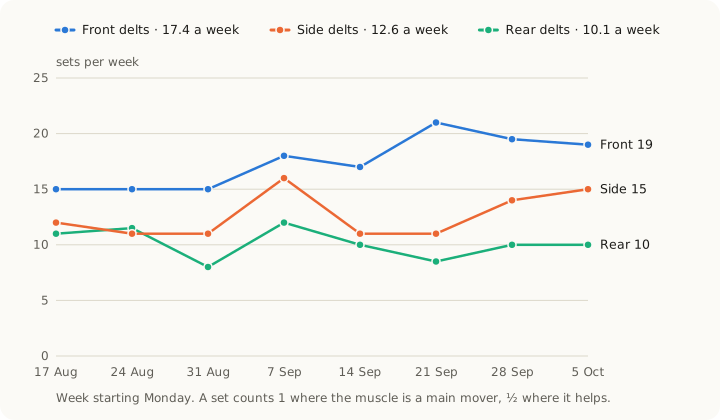
- My front delts got 1.7 times the work of my rear delts. From 17 August to 11 October: 17.4 sets a week for the front, 12.6 for the side, 10.1 for the rear. Counting only sets where the rear delts were the main mover: 7.1.
- I never trained my front delts on purpose. No front raises in those eight weeks. Every set came from pressing.
- The split found a weak spot I wasn't looking for: my traps got 2.8 sets a week, all of it as a helper.
- Sparlift now shows 19 muscles instead of 14. Each part of the shoulders and the back has its own recovery clock, and you can zoom in on them on the body.
- An app can't tell you why a shoulder hurts. It can show you where your training goes.
What the research says about shoulders and balance
"We train the front and skip the back" is our explanation at the club. It isn't proof. Here's what the studies say:
- The shoulder is where lifters get hurt most often. In a review of resistance-training injuries, up to 36% of the documented ones were at the shoulder. The authors point to muscle imbalances and poor technique as likely causes, but most of the evidence comes from surveys done after the fact (Kolber et al., 2010).
- Imbalance goes with shoulder trouble, but that doesn't prove it causes it. Recreational lifters with signs of shoulder impingement were more likely to do lateral raises and upright rows above shoulder height, and less likely to train their external rotators, the small muscles at the back of the shoulder that turn the arm out (Kolber et al., 2014).
- Training the back of the shoulder helps. In a trial with 660 elite handball players, a 10-minute warm-up three times a week (external-rotation strength, shoulder-blade control and upper-back mobility) made shoulder problems 28% less likely over a season (Andersson et al., 2017). Handball isn't kickboxing, but it's the same joint.
- In fights, the head and the legs take most of the damage. Over 15 years of kickboxing bouts in Nevada, 58% of injuries were to the head and 26% to the legs (Lystad, 2015). So the shoulder problems at my club are probably a training story more than a fight story: a lot of pressing in the gym, a lot of punching in class, and very little work for the back of the shoulder.
Why one "Shoulders" clock couldn't see it
Sparlift keeps a recovery clock for each muscle: every hard set adds hours, and the clock counts down until the muscle reads Fresh again (how the clock works). Until this week, the shoulders were one muscle. An overhead press, a lateral raise and a face pull all fed the same clock.
That has two problems.
It can't show balance. A week of bench press and overhead press, and a week of face pulls and rows, both read as "shoulders worked". A program that's all pressing looks fine.
It adds up work that different muscles did. Take three hard sets of overhead press (heavy, taken to failure), and four of face pulls:
| Hours until Fresh | Old "Shoulders" clock | Front delts | Side delts | Rear delts |
|---|---|---|---|---|
| Overhead press only | 47 h | 47 h | 47 h | Fresh |
| + 4 sets of face pulls, same workout | 65 h, Taxed | 47 h | 47 h | 48 h |
| + 4 sets of face pulls, 2 hours later | 100 h, Overreached | 45 h | 45 h | 48 h |
No part of the shoulder did more than four hard sets. The old clock added the press and the face pulls up as if one muscle had done all of it, and called it Overreached, four days from ready. Each part needs about two days, which is what three or four sets close to failure usually take (Morán-Navarro et al., 2017).
What changed in Sparlift
This week:
- 19 muscles instead of 14. Shoulders are now front, side and rear delts. Back & traps is now lats, upper back, traps and lower back. The other twelve muscles haven't changed.
- Every exercise is tagged with the parts it trains, as a main mover or a helper, and it can have more than one main mover: the overhead press is a main mover for both the front and the side delts.
- Each part has its own recovery clock, fed only by the exercises that train it, with its muscle's recovery time: about 48 hours after three hard sets. I found no evidence that the heads of one muscle recover at different speeds, so they don't get different times.
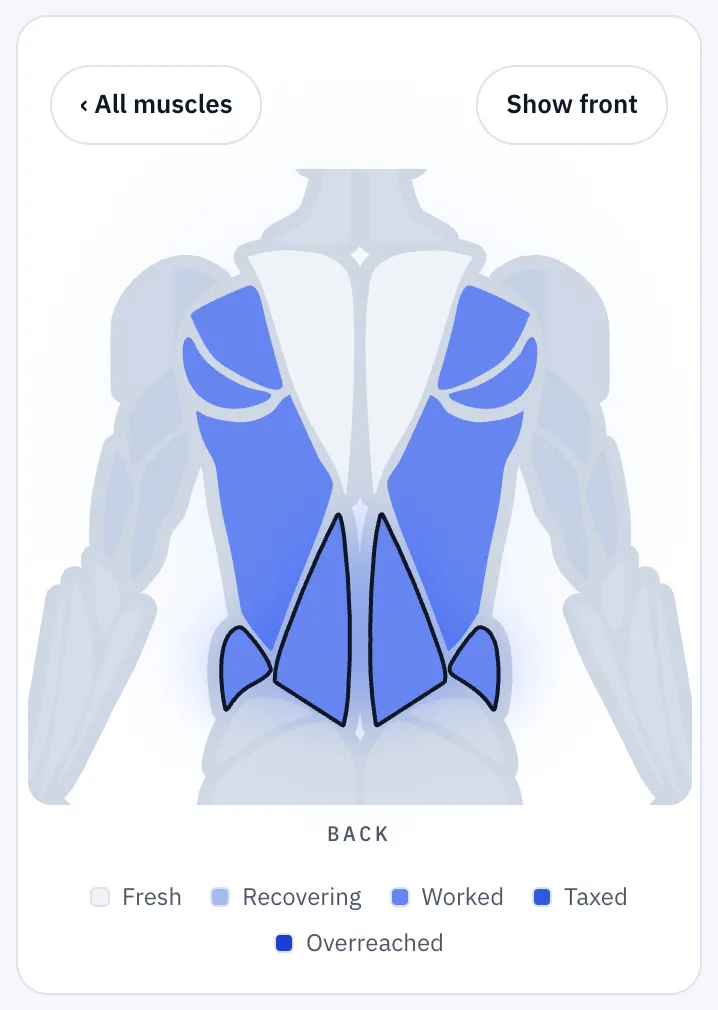
- Tap the shoulders or the back on the body and it zooms in on that side, with the parts listed underneath.
- A muscle that reads Fresh still shows what trained it. Two easy sets of lateral raises used to leave the side delts at "Fresh · 0 workouts". Now it says "Fresh · 1 workout".
Two changes came from my own log, not from studies. The docs list both, with how much evidence is behind them:
- Incline presses count the front delts as a main mover. The front delts work harder the steeper the bench (study). On the Tuesday evening below, my front delts read 27 hours with the first version of the split, less than they felt like. With this change they read 39.
- Deadlifts count for the lower back even when the sets aren't close to failure. More on that below.
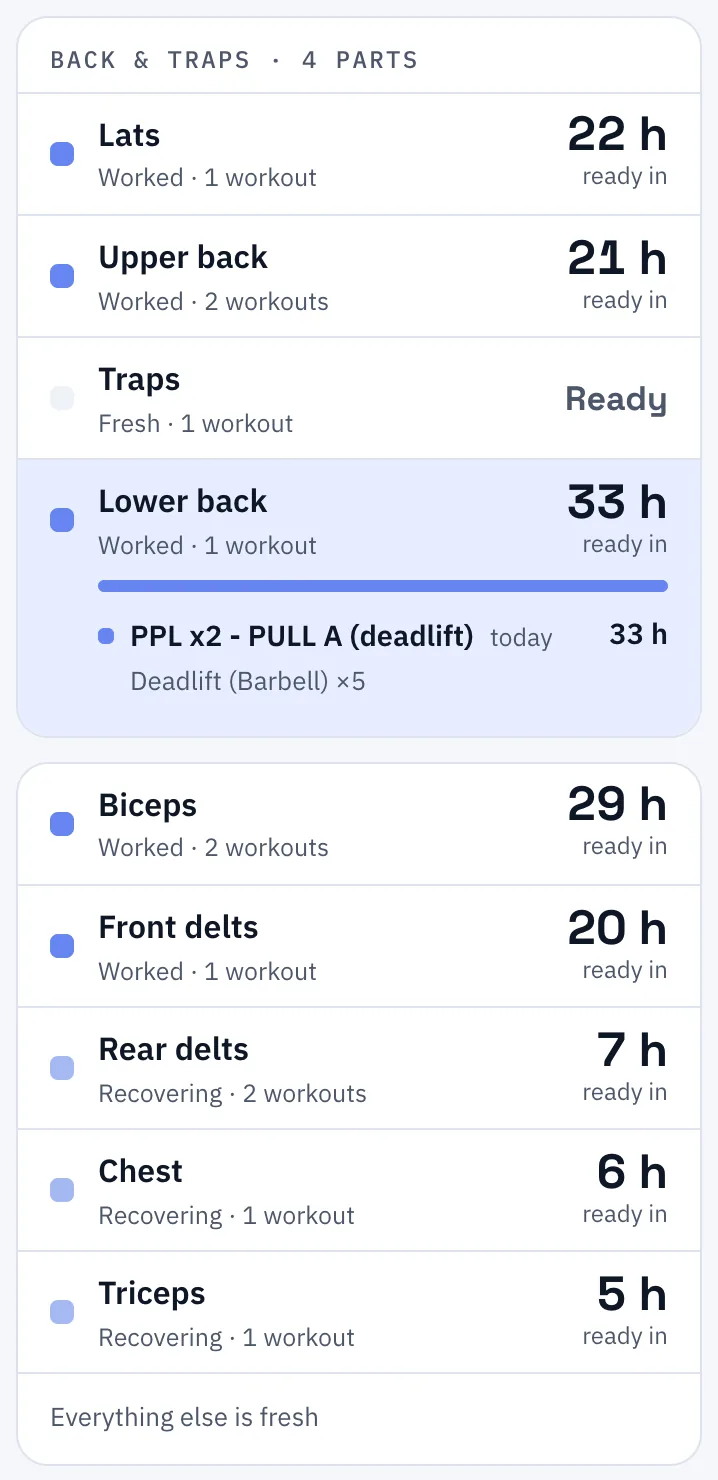
Before and after: the same Tuesday evening
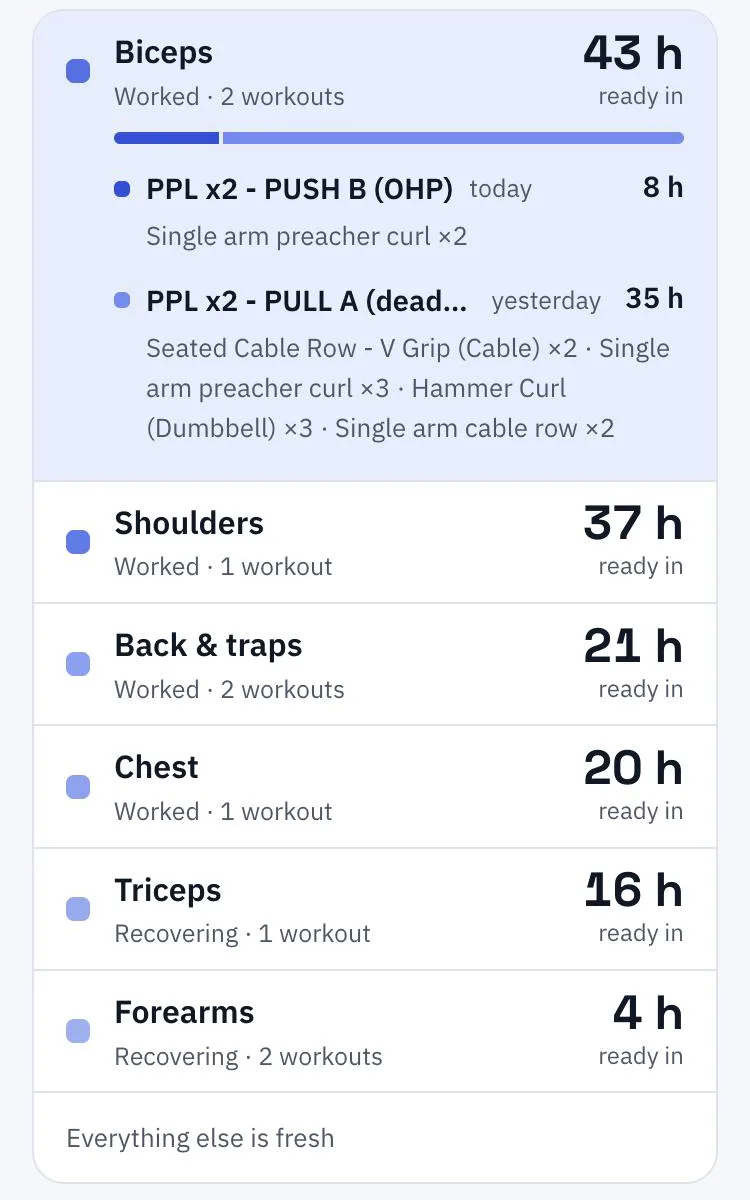
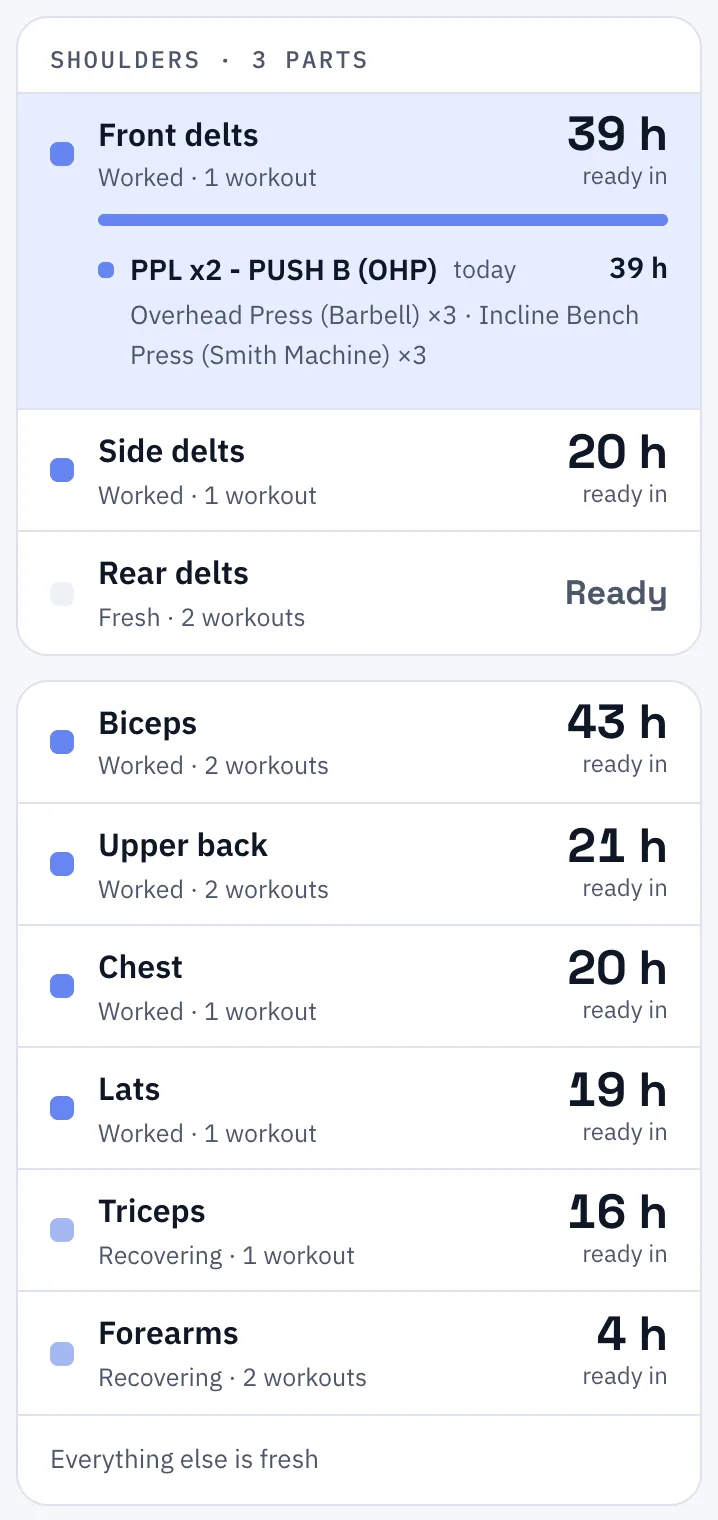
This is the evening of Tuesday 29 September: a pull day on Monday night (rows and curls), and a push day on Tuesday (overhead press, incline press, lateral raises, two sets each of face pulls and rear-delt flies). It's also the worked example in the docs.
| Before | After |
|---|---|
| Shoulders: 37 h | Front delts 39 h · Side delts 20 h · Rear delts Ready |
| Back & traps: 21 h | Upper back 21 h · Lats 19 h · Traps Ready · Lower back Ready |
The old number was about right for my front delts and wrong for everything else. My side delts needed 20 hours, not 37. My rear delts were already Fresh: I hadn't logged reps in reserve on the face pulls and rear-delt flies, and next to my best sets on those cables they looked far from failure, so they counted for very little. The old screen said "shoulders, 37 hours" about all three parts. The new one shows that my rear delts were ready the next day.
My deadlift day: what the old count missed in my lower back
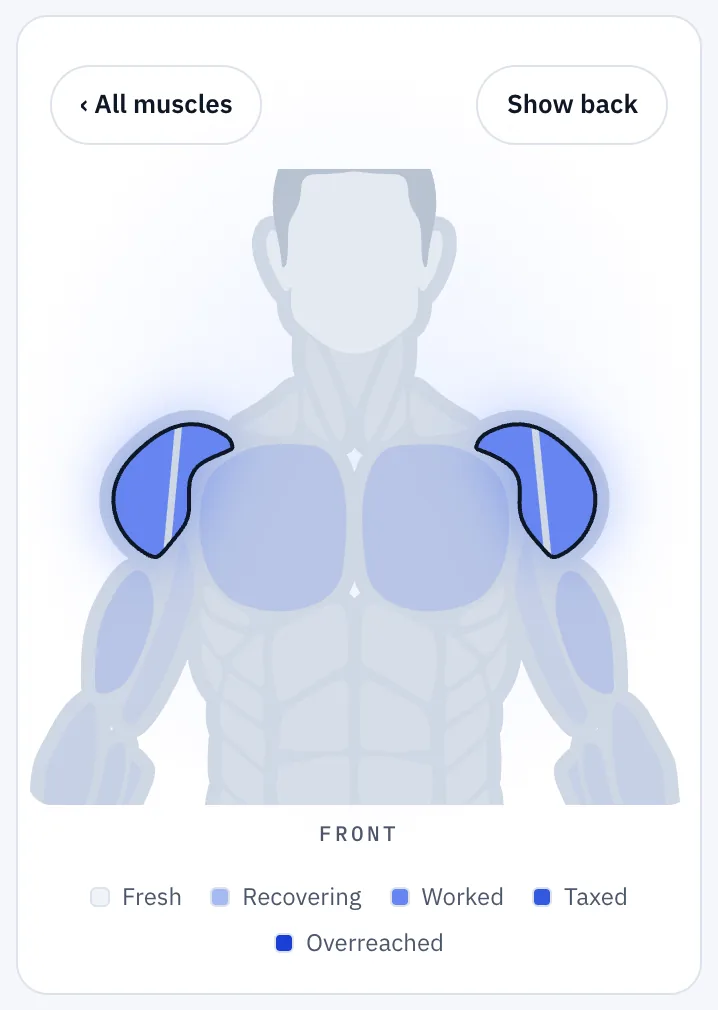
The back split showed a different problem. My deadlift day on Sunday 11 October was three ramp-up sets (60, 100 and 130 kg), one triple at 150 kg and a back-off set of five at 100. My estimated best is about 170 kg, so most of those sets were far from failure, and the model counts effort: the whole day counted as 0.4 of a hard set. My lower back read Fresh almost straight away. It didn't feel fresh.
How close a set is to failure is the best guide to how long a muscle needs (Morán-Navarro et al., 2017). But your lower back holds the bar on every rep of a deadlift, easy set or not. So now every deadlift set at half your best or more counts as at least 0.6 of a hard set for the lower back. The same Sunday evening, it read 33 hours.
To be clear: this one is my own calibration, not a research result. I couldn't find a study that measured how long the lower-back muscles need after deadlifts. In one study of well-trained men, deadlifts taken to failure recovered no slower than squats or bench press (Belcher et al., 2019). I'll keep checking it against how my back feels, and change it if the log says so.
What eight weeks of my log show
To see the balance, I counted every set from 17 August to 11 October for each part: 1 set where the part is a main mover of the exercise, half a set where it helps. These are the sets I did, before the model judges how hard they were.
| Part | Sets a week | As the main mover | Where the sets came from |
|---|---|---|---|
| Front delts | 17.4 | 13.0 | Incline press, overhead press, dumbbell shoulder press; bench press and cable flies as a helper; bag work |
| Lats | 16.4 | 13.9 | Rows, pulldowns; deadlifts as a helper |
| Upper back | 15.9 | 6.0 | Rows; rear-delt flies, deadlifts, pulldowns and face pulls as a helper |
| Side delts | 12.6 | 12.6 | Lateral raises, overhead press, dumbbell shoulder press, bag work |
| Rear delts | 10.1 | 7.1 | Rear-delt flies and face pulls; rows as a helper |
| Lower back | 6.4 | 4.8 | Deadlifts; barbell rows, Romanian deadlifts and farmer's walks as a helper |
| Traps | 2.8 | 0 | Only as a helper: deadlifts and farmer's walks |
Four things stand out:
- The front got more work than the rear every week, 1.7 times as much on average. The gap grew in late September, when I trained three push days a week.
- None of the front-delt work was planned. It all came from pressing. That's the hidden shoulder work you don't see when you plan "chest day". In Sparlift, pads, bag rounds, shadowboxing and sparring also count for the front and side delts, never the rear.
- My rear delts got their main-mover sets from two exercises, rear-delt flies and face pulls, two sets each at the end of push days. They show up in 34 of my 41 sessions, but mostly at half weight, as helpers in rows.
- My traps got 2.8 sets a week, none of them as the main mover. In those eight weeks I didn't do a single shrug or upright row. I wasn't looking for that at all.
For context: more weekly sets build more muscle, at least up to about ten sets per muscle a week (Schoenfeld et al., 2017). By that measure my rear delts are borderline, and my traps are barely trained.
What I'm trying in my next block
- Rear delts get their own slot on pull days too, not just two sets at the end of a push day: three sets of reverse flies or a reverse pec deck, twice a week.
- Face pulls and external rotations in my warm-up before pressing. The idea comes from the handball program: a few minutes for the back of the shoulder before the front gets loaded.
- Shrugs or farmer's walks once a week, so the traps get some main-mover work.
- Lateral raises stop at shoulder height.
- No hard overhead pressing the day after hard bag rounds. The app now shows both on the same front and side delt clocks, so I can see when they stack.
I'll come back in a few weeks with the new numbers.
Start logging, free · How the recovery clock works, every formula and source: the muscle recovery model.
FAQ
How do I protect my shoulders if I lift and do kickboxing?
Keep the front and the back of the shoulder in balance, and count everything that loads them. Pressing and punching both work the front delts, so give the rear delts and the external rotators their own sets: rear-delt flies or a reverse pec deck, face pulls, rows. A 10-minute warm-up for external rotation and shoulder-blade control made shoulder problems 28% less likely in handball players (Andersson et al., 2017). And if a shoulder keeps hurting, get it checked by a physio. An app can't tell you what's going on in a joint.
How often can I train shoulders without overdoing it?
Two or three times a week works for most people, with about 48 hours between hard sessions for the same part. Count the hidden work: bench and incline press train the front delts, and bag rounds train the front and side delts. If a part still reads Worked when its next session comes, train another part that day or go lighter.
How long do shoulders take to recover?
About 48 hours after three sets taken to failure, the same as the chest and the back. Fewer or easier sets need less (Morán-Navarro et al., 2017). One big session can leave up to about 72 hours. The front, side and rear delts recover at the same rate; what differs is how much work each one got.
Do I need to train front delts if I bench press?
Usually not. The front delts work hard in every press: in one study they reached about 55% of their maximum in a bench press and 70% in a machine shoulder press (study). In my eight weeks they got 17 sets a week without a single front raise.
Does the overhead press work the side delts?
Yes, almost as much as lateral raises. In 13 trained men, the side delts reached 28% of their maximum in a shoulder press and 30% in a lateral raise, but only 5% in a bench press (study). That's why the overhead press counts for the side delts in Sparlift and the bench press doesn't.
How many sets a week do rear delts need?
There's no exact number for rear delts. For muscles in general, more weekly sets build more muscle, up to at least about ten a week (Schoenfeld et al., 2017). Rows help, but only as a helper. If your rear delts only ever work in rows, give them a few direct sets twice a week.
What are the best rear delt exercises?
Exercises that pull the arms back and out, with the elbows high. In one study the rear deltoid reached about 90% of its maximum in a reverse pec deck, far more than in any press or raise (study). Rear-delt flies and face pulls work the same way, and wide-grip rows train the rear delts along with the upper back.
Are lateral raises bad for your shoulders?
Not on their own. In one study of recreational lifters, signs of shoulder impingement were more common in those who raised their arms above shoulder height in lateral raises and upright rows, and less common in those who trained their external rotators (Kolber et al., 2014). That's an association, not a cause. Stopping at shoulder height costs nothing, so that's where I stop mine.
Why does my app say my shoulders are fresh when I trained them today?
A few easy sets leave a muscle less than 15% of its recovery time, so it still reads Fresh: you could train it again. In Sparlift the session still counts: the row says "Fresh · 1 workout" and lists it. If your hard sets read too light, log your reps in reserve. Without them, the app judges each set against your best one (how that works).
Can a training app prevent shoulder injuries?
No. Sparlift estimates when a muscle can perform again from the sets you log. It can't see your joints, your technique or your sleep. What it can do is show you where your training goes, so a month of pressing with almost no pulling is easy to spot.