How Sparlift counts training stress and rest days
The open model behind Sparlift's training stress in %: built from your working sets over weeks, cleared by a deload week. Formulas, evidence, my own log.
Sparlift shows your whole-body training stress as a percentage. It builds over weeks and clears in about a week, the way a training block and its deload week do. Your last 7 days of training set where it's heading:
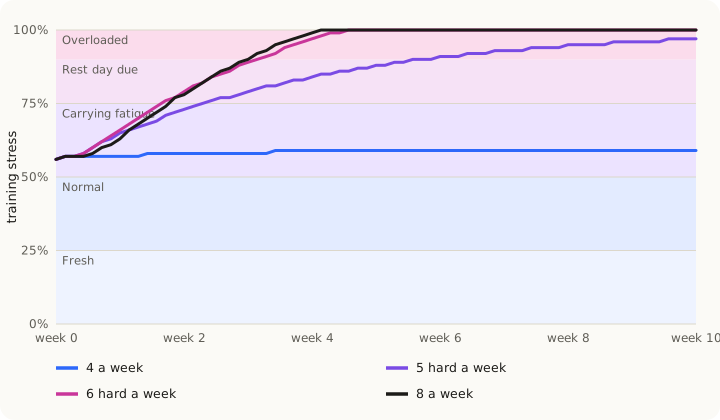
- Four normal sessions a week hold it at about 55%, week after week.
- Five or six hard sessions a week take it into Overloaded in about 3–6 weeks. Eight or more a week take about 2–3 weeks.
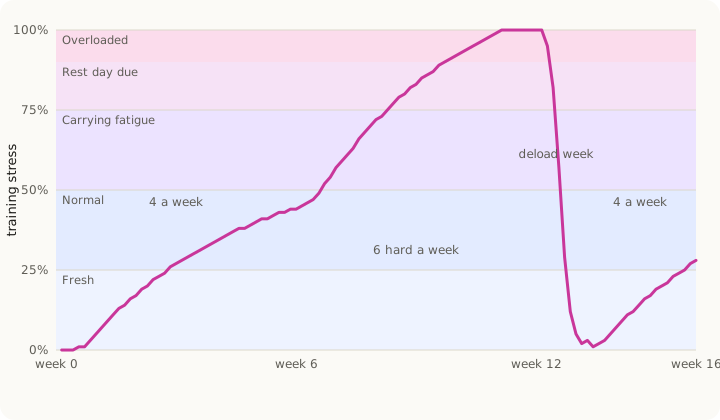
- A deload week of light training brings it from 100% back under 10%.
| Training stress | Band | What it means for today |
|---|---|---|
| 0–25% | Fresh | Rested: room to push |
| 26–50% | Normal | A sustainable load: keep going |
| 51–75% | Carrying fatigue | Training hard; plan a deload within a few weeks |
| 76–90% | Rest day due | Ease off: an extra rest day or lighter sessions this week |
| 91–100% | Overloaded | Time for a deload week: about a week of light training |
This is what the app's Nervous system view shows. Everything comes from the sets and rounds you tick, and the app never asks how you feel. On this page I give every formula, where each number comes from, and what the model reads on my own log.
Summary
- Units. Every working set you tick counts 1, times its effort and how big the lift is. Effort is 1 when you didn't log it, more near failure, less far from it. Big lifts count more: a curl 0.72, a deadlift 1.4. Rounds count by minutes and RPE.
- Session size. Units ÷ 12, in normal sessions. A normal session is about 13 working sets of mixed lifts. Above one normal session, the square root: four times the sets is twice the size.
- The week. The sizes of your sessions in the last 7 days, today included.
- Where it's heading. 0% up to 2.5 sessions a week, 60% at 4, and 18 points more for every session above 4.
- Each day the training stress moves 3.5% of the way up toward where it's heading, or 60% of the way down. Up takes weeks; down takes days.
- Facts. The 7-day load, where it's heading, training days in a row, rest days in the last 7, and how many easy days would bring you back to Fresh.
Why weeks, not days
Strength athletes train in blocks: weeks of hard work, then a lighter week. In a survey of 246 competitive strength and physique athletes, every one of them deloaded, for about 6 days (6.4 ± 1.7) every 5–6 weeks (5.6 ± 2.3) (Rogerson et al., 2024). The fatigue that matters for a lifter's week builds over weeks of training. A single day doesn't build it up, and a single rest day doesn't clear it.
My first two versions of this view, both from October 2026, worked in days. The second took 30 points off every night, and it read six normal sessions in a row as Overloaded, even after one big week from a four-day base. That's too fast:
- One big week is normal. Spreading the same weekly sets over 3 or 6 days gives the same results (Saric et al., 2019; Yang et al., 2018). One week of six from a four-a-week base now reaches about 62%: Carrying fatigue.
- Weeks of it are not. Two weeks of daily maximal lifting cut strength and power, and it took weeks to get back (Fry et al., 2006). Frequent sessions each cost more (Busso, 2003).
- A lighter week clears it. Cutting volume for one to two weeks lets fatigue clear while fitness stays (Bosquet et al., 2007).
Why sets, not minutes × effort
My first version of this account (2 October 2026) worked from session effort × minutes. On my own log it read six training days in a row as "Recovered, 1 hour". Two of its inputs failed on a real log:
- Effort is rarely logged. In two weeks, only 15 of my 163 logged sets had a reps-in-reserve value. Without one, the app inferred the effort from my best sets. My ordinary working sets read as easy, and whole sessions read as "light".
- The clock is often wrong. When I start a workout late or log it afterwards, it lasts minutes on paper. My 34-minute leg day counted as a light day, which meant a rest day.
The sets are always in the log. A working set you ticked happened. Most working sets end 1–3 reps short of failure, so an unlogged set counts as a normal one. A logged effort only nudges it up or down.
Why an account, not "compared with your usual"
Until October 2026 this view compared your last two days with your last three weeks. Your "usual" learns your routine: train every day for three weeks, and that becomes usual. That's how it read my six days in a row as "Below your usual".
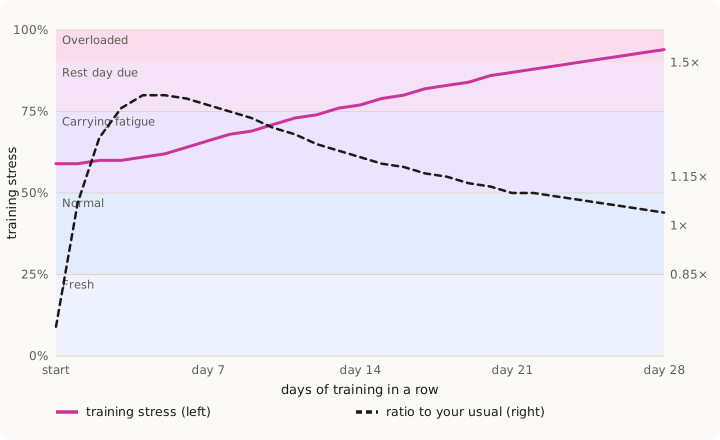
The ratio models used in sports science, and the fitness–fatigue charts, all have this blind spot. With the same load every day, both averages settle on the same number. They measure change, not how much training you can keep absorbing (Impellizzeri et al., 2020; Lolli et al., 2019). To say "too much, for weeks", a model needs a fixed scale. Here, that's the number of sessions in a week.
Step 1 — a session's units
units = Σ over working sets: effort × systemic
effort   = 1                       when not logged (a normal working set)
         = 1.3 − 0.15 × RIR        when RIR (or RPE, as RIR = 10 − RPE) is logged; at least 0.5
         = 0.5                     for a set under half your best e1RM (a warm-up in all but name)
systemic = 0.6 + 0.8 × the exercise's systemic load (0–1 in the catalogue)
| Set | Units |
|---|---|
| Bench press, effort not logged (systemic load 0.7) | 1.16 |
| Deadlift, effort not logged (1.0) | 1.40 |
| Curl or lateral raise, effort not logged (0.15) | 0.72 |
| Bench press to failure, RIR 0 | 1.51 |
| Bench press with 4 reps left, RIR 4 | 0.81 |
Warm-ups and sets you didn't tick don't count.
A left/right pair is one set; the harder side counts.
A timed strength set (plank, carry) counts half a set.
Rounds and timed blocks count by minutes and effort:
units = minutes ÷ 3 × ((RPE − 3) ÷ 4.5)^1.5Three minutes at RPE 7.5 is one unit. An hour of sparring at RPE 8 is 23 units, more than a hard lifting session. 45 minutes of technique at RPE 5 is 4.4 units, an easy day. RPE is the one you logged, else the activity's default.
Step 2 — a session's size
size = units ÷ 12          up to one normal session
     = √(units ÷ 12)       above it
| Session | Units | Size (sessions) |
|---|---|---|
| A short session, 5 sets | ~5 | 0.42 |
| An easy BJJ technique class, 45 min at RPE 5 | 4.4 | 0.37 |
| A normal session, ~13 working sets of mixed lifts | 12 | 1.0 |
| A hard session, ~16 sets near failure with big lifts | 19 | 1.26 |
| Sparring, 60 min at RPE 8 | 23 | 1.40 |
| Two normal sessions on one day | 12 + 12 | 2.0 |
Half the sets is half a session. Above one session, more sets add less and less: the muscle model uses the same idea above three hard sets. Two sessions on one day are two sessions.
Step 3 — where the week is heading
week  = the sizes of all sessions in the last 7 days, today included
level = 0                          up to 2.5 sessions
      = 60 × (week − 2.5) ÷ 1.5    from 2.5 to 4
      = 60 + 18 × (week − 4)       above 4
| Sessions in 7 days | 2.5 or fewer | 3 | 3.5 | 4 | 5 | 6 | 7 | 8 |
|---|---|---|---|---|---|---|---|---|
| Heading for | 0% | 20% | 40% | 60% | 78% | 96% | 114% | 132% |
Two or three sessions a week leave little that lasts. Four a week is a solid training load. Every session above four raises the target by 18 points. From about six sessions a week, the target is above Overloaded.
Step 4 — each day's step
gap     = level − stress
stress += 3.5% × gap    when the level is higher (it climbs over weeks)
stress += 60% × gap     when the level is lower (it falls within days)
0 ≤ stress ≤ 130 inside; the app shows at most 100%
- Up slowly. 3.5% a day closes about a fifth of the gap in a week, and half of it in three weeks.
- Down fast. 60% a day: a light week, with the hard days dropping out of the 7-day window, takes 100% down to about 5%.
- A day ends at 04:00. A session at 01:00 belongs to the evening before.
- Today counts right away. Your sets go into this week's load the moment you tick them, so the target and today's reading move before you finish.
- Up to 130 inside. A long block reads Overloaded for a while, and its deload takes a day or two longer.
- Months of history. The app reads your last 120 days. The account starts empty, so it needs a few weeks of logging before it means much.
Where the numbers come from
I fitted the four constants (2.5 sessions free, 60% at 4, 18 points per extra session, 3.5% up and 60% down) to the requirements below. They're what I expect from my own training, each checked against the evidence:
| Requirement | Why | Result |
|---|---|---|
| Four normal sessions a week hold 50–70% for as long as you keep it up | A common, sustainable lifting week; frequency doesn't matter when weekly volume is the same (Saric et al., 2019; Yang et al., 2018) | 54–59% |
| Five or six hard sessions a week reach Overloaded in about 4–6 weeks | Deloads come every 5–6 weeks in strength sports (Rogerson et al., 2024); weeks of hard training without easy days went with illness (Foster, 1998) | 5 hard: 6.0 weeks · 6 hard: 3.3 weeks |
| More than seven sessions a week reach Overloaded in about 2–3 weeks | Two weeks of daily maximal lifting cut performance for weeks (Fry et al., 2006) | 8 a week: 3.1 weeks · 10 a week: 2.0 weeks |
| A deload week brings Overloaded down to 0–10% | Deloads last about 6 days (Rogerson et al., 2024); a lighter week or two clears fatigue (Bosquet et al., 2007) | 100% → 5% in a week of 3 light sessions |
| Easy technique every day stays Fresh | Easy days let fatigue clear (Dupuy et al., 2018) | 3% after ten weeks |
| One week of six from a four-a-week base isn't Overloaded | One big week is ordinary training, not overload | 62% at most |
What you see
- Training stress in %, and its band.
- This week: the 7-day load in sessions, and whether it's heading up ("heading for 82%"), down ("easing toward 40%") or holding.
- Days in a row. Training days, today included once you've trained. A day under a quarter of a normal session, such as a walk or two or three sets, counts as a rest day.
- Rest days in the last 7.
- Easy days to Fresh. How many days with nothing logged would bring you back to 25% or below.
- Last 14 mornings, each in its band's colour.
The body fills with water up to the percentage. Above the dashed line at 75%, a rest day is due.
How common weeks read
| End of week | 0 | 1 | 2 | 3 | 4 | 5 | 6 | 8 |
|---|---|---|---|---|---|---|---|---|
| Four normal a week | 56% | 57% | 58% | 58% | 59% | 59% | 59% | 59% |
| Six normal a week | 56% | 62% | 70% | 75% | 80% | 83% | 86% | 90% |
| Five hard a week | 56% | 65% | 73% | 79% | 84% | 88% | 91% | 95% |
| Six hard a week | 56% | 66% | 79% | 89% | 97% | 100% | 100% | 100% |
| Eight a week | 56% | 63% | 78% | 90% | 99% | 100% | 100% | 100% |
Bold: Rest day due or Overloaded.
- A deload week after a block at 100% (light sessions on Monday, Wednesday and Friday), each morning: 100, 97, 83, 58, 29, 12, 5%.
- A week off after the same block, each morning: 100, 90, 67, 27, 11, 4%.
- Three normal sessions a week: 20%, Fresh, for as long as you keep it up.
- Normal sessions every day, from a four-a-week base: Rest day due after about two weeks, Overloaded after about three and a half.
- Easy technique every day: 3% after ten weeks.
My own log
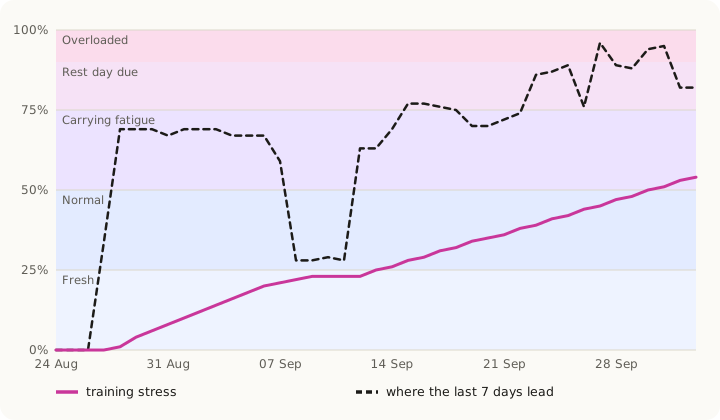
I lift on a push/pull/legs split, five or six days in most weeks since late August. From Sunday 27 September to Friday 2 October that was six days in a row: push, pull, push, pull, push, legs. That's 16, 15, 16, 13, 17 and 5 working sets, and I logged the effort on almost none of them.
| Morning | Sun 27 | Mon 28 | Tue 29 | Wed 30 | Thu 1 | Fri 2 | Sat 3 |
|---|---|---|---|---|---|---|---|
| Training stress | 45% | 47% | 48% | 50% | 51% | 53% | 54% |
| Band | Normal | Normal | Normal | Normal | Carrying | Carrying | Carrying |
| 7-day load, sessions | 6.0 | 5.6 | 5.5 | 5.9 | 5.9 | 5.2 | 5.2 |
| Heading for | 96% | 89% | 88% | 94% | 95% | 82% | 82% |
| Old ratio to my usual | 0.63× | 0.91× | 0.98× | 1.15× | 1.13× | 0.98× | 0.79× |
On Saturday it read 55%, Carrying fatigue: day 6 in a row, 1 rest day in the last 7, this week 5.2 sessions and heading for 82%. Six weeks at this pace have built it up. If my next weeks look the same, it reaches Rest day due in about a month, and that's when I plan a deload. That Saturday, the old ratio said "Below your usual", and my first version of the account said "Recovered, 1 hour".
These figures use six weeks of my log, from 24 August, and the account starts empty there. The app reads 120 days, so its numbers for me can be a little higher.
The trend line: load vs your last 3 weeks
The old reading stays as one line under the account. It compares your last two days with your last three weeks (the formula is in the muscle recovery model). At 1.15× or more, you've jumped above what you've been doing. That's useful after a break or an unusually big week. It can't say whether what you've been doing is too much; that's the account's job.
Why "Nervous system" isn't a measure of your nerves
After heavy squats, voluntary activation (the measure of fatigue in the nervous system) was back within 24–48 hours. Muscle function took up to 72 (Thomas et al., 2018; Carroll et al., 2017). What builds up over weeks of training is whole-body training stress, and that's what this view counts.
Common questions
When do I need a deload week?
By Sparlift's model, when it reads Overloaded, or when Rest day due holds for a week or more. About a week of light training, such as half the sets of your usual sessions, brings it back under 10%. Many lifters plan one every 5–6 weeks anyway.
Do I need rest days if I train every day?
Over weeks, yes. One week of daily training reads Carrying fatigue at most. Keep it up with normal sessions and it reaches Rest day due in about two weeks and Overloaded in about three and a half; hard sessions get there sooner. Easy days, such as technique, mobility or a walk, add little.
How many sessions a week can I keep up?
Four normal sessions a week hold about 55–59%, the low end of Carrying fatigue, for as long as you keep them up. Three a week stay Fresh. Each session above four raises where you're heading by 18 points.
Do I need to log RIR?
No. Every working set counts as a normal one. Logging RIR on sets close to failure makes them count a bit more, and on easy sets a bit less.
Does the workout length matter?
No. The work is counted from the sets, so a workout logged after training reads the same as one timed live.
Limits
- The numbers are starting values. The constants come from the requirements above and my own weeks, not from your body. Recovery varies with age, sleep and training history; a lifter used to six days a week may hold more.
- Sleep, stress and illness aren't seen. Life stress measurably slows recovery after hard lifting (Stults-Kolehmainen et al., 2014), and sleep matters (Walsh et al., 2021).
- Only what you log. Classes you don't log aren't counted.
- For planning, not a medical assessment. Real fatigue doesn't move 3.5% a day. The account is a simple stand-in that matches the findings above.
References
- Bosquet L. et al. (2007). Effects of tapering on performance: a meta-analysis. Medicine & Science in Sports & Exercise 39(8):1358–1365. Link
- Busso T. (2003). Variable dose-response relationship between exercise training and performance. Medicine & Science in Sports & Exercise 35(7):1188–1195. Link
- Carroll T. J. et al. (2017). Recovery of central and peripheral neuromuscular fatigue after exercise. Journal of Applied Physiology. Link
- Dupuy O. et al. (2018). An evidence-based approach for choosing post-exercise recovery techniques. Frontiers in Physiology 9:403. Link
- Foster C. (1998). Monitoring training in athletes with reference to overtraining syndrome. Medicine & Science in Sports & Exercise 30(7):1164–1168. Link
- Fry A. C. et al. (2006). β2-adrenergic receptor downregulation and performance decrements during high-intensity resistance exercise. Journal of Applied Physiology 101(6):1664–1672. Link
- Impellizzeri F. M. et al. (2020). Acute:chronic workload ratio: conceptual issues and fundamental pitfalls. International Journal of Sports Physiology and Performance. Link
- Lolli L. et al. (2019). Mathematical coupling causes spurious correlation within the conventional acute-to-chronic workload ratio calculations. British Journal of Sports Medicine 53:921–922. Link
- Rogerson D., Nolan D., Korakakis P. A., Immonen V., Wolf M., Bell L. (2024). Deloading practices in strength and physique sports: a cross-sectional survey. Sports Medicine – Open 10. PMC
- Saric J. et al. (2019). Resistance training frequencies of 3 and 6 times per week produce similar muscular adaptations in resistance-trained men. Journal of Strength and Conditioning Research. PubMed
- Stults-Kolehmainen M. A. et al. (2014). Chronic psychological stress impairs recovery of muscular function and somatic sensations over a 96-hour period. Journal of Strength and Conditioning Research 28(7):2007–2017. PubMed
- Thomas K. et al. (2018). Neuromuscular fatigue and recovery after heavy resistance, jump, and sprint training. Medicine & Science in Sports & Exercise. PubMed
- Walsh N. P. et al. (2021). Sleep and the athlete: narrative review and 2021 expert consensus recommendations. British Journal of Sports Medicine 55(7):356–368. Link
- Yang Y. et al. (2018). Effects of consecutive versus non-consecutive days of resistance training on strength, body composition, and red blood cells. Frontiers in Physiology. PMC